TransRe: Reserve Study
How I replaced a spreadsheet-run reinsurance workflow with one system and made data retrieval ~80% faster
The reserve data holding up a reinsurance business lived in spreadsheets that were emailed around.
Sole product designer: contextual research with the people who lived in those spreadsheets, the dense data tables, and the advanced multi-criteria filter at the core of the product.
Role
Product Designer
Category
Insurance / Reinsurance
Timeline
2023 to 2024
1
Source of truth, not dozens of files
~60%
Fewer data errors
1000s
Records handled in one view
Hrs/wk
Saved per employee
“Reserve Study feels more powerful than Excel, not more restrictive.”
Client feedback
Overview
The contextTransRe's employees were running a critical part of their insurance operations on Excel spreadsheets. Reserve data, large, complex, and constantly updated, was scattered across sheets that were emailed around, duplicated, manually edited, and prone to breaking. For a business where accuracy is everything, this was a serious operational risk.
Reserve Study was our answer: a purpose-built internal CRM that transformed TransRe's spreadsheet-driven workflow into a structured, reliable platform. At its heart, this was a data-heavy design challenge, thousands of records, dozens of attributes, and users who needed to slice, filter, and analyze that data quickly and confidently. The centerpiece of the experience was a powerful advanced filtering system that let employees find exactly the data they needed in seconds instead of scrolling through endless spreadsheet rows.
Challenge
The problemExcel is where many business processes start, and where many get stuck. For TransRe, the spreadsheet-based workflow created problems at every level:
No single source of truth
Data lived in multiple copies of multiple files. Different employees worked from different versions, and reconciling them was manual, slow, and error-prone. In insurance, where reserve figures inform serious financial decisions, version chaos is not a small problem.
Spreadsheets don't scale with data
As the volume of records grew, the sheets became slow, fragile, and hard to navigate. Finding a specific subset of data meant manual sorting, temporary filters, and scanning across dozens of columns, every single time.
No structure, no safeguards
Excel enforces nothing. A mistyped value, a broken formula, or an accidentally deleted row could silently corrupt data with no trail of what changed or who changed it.
Filtering was the biggest daily pain
Employees constantly needed specific slices of the data, by line of business, period, status, or combinations of many criteria at once. Excel's filtering was too limited and too manual for the complexity of their real questions.
The core problem: a data-critical insurance workflow was running on a tool never designed for it, and the design challenge was to replace it with a system that felt more powerful than Excel, not more restrictive.
Approach
The processUnderstand the data before designing the screens
In a data-heavy product, the data model is the design. We studied how employees actually used their spreadsheets, which columns mattered, which views they recreated repeatedly, what questions they were really asking, and let that shape the entire information architecture.
Design for density without overwhelm
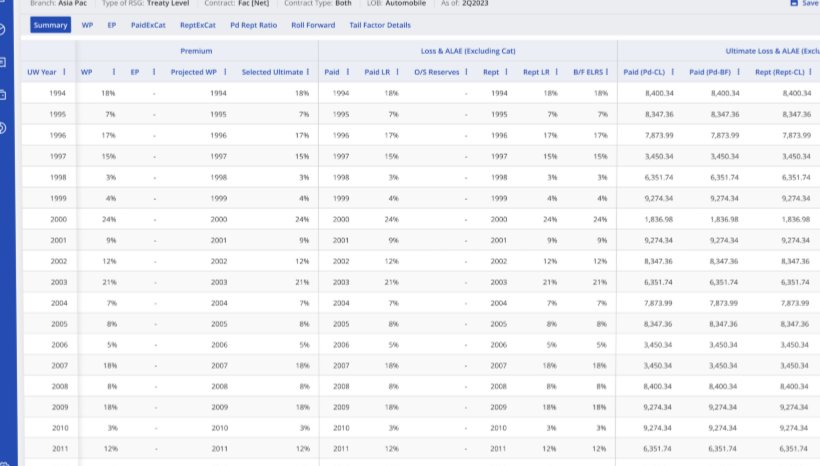
Reserve Study had to display a lot of data, that was non-negotiable. Rather than hiding information, we designed dense, scannable tables with careful typography, alignment, and hierarchy, so large datasets stayed comfortable to read. Key details were always visible; deeper details one click away.
Advanced filtering as the core feature
The advanced filter system became the heart of the product. Employees stack multiple criteria across any attributes to answer complex questions in seconds. Filters were powerful but approachable: clear chips for active conditions, easy editing and removal, and instant feedback on results.
Replace Excel without losing what people loved
Excel users are used to freedom, so we kept the strengths, fast scanning, familiar table interactions, sorting, while adding what Excel never could: a single shared source of truth, structured data entry, and consistency across the team.
Built for trust
Because the data drives insurance decisions, the design emphasized clarity and confidence: explicit states, clear feedback on every action, and structured inputs that prevent the silent errors spreadsheets are notorious for.
Outcome
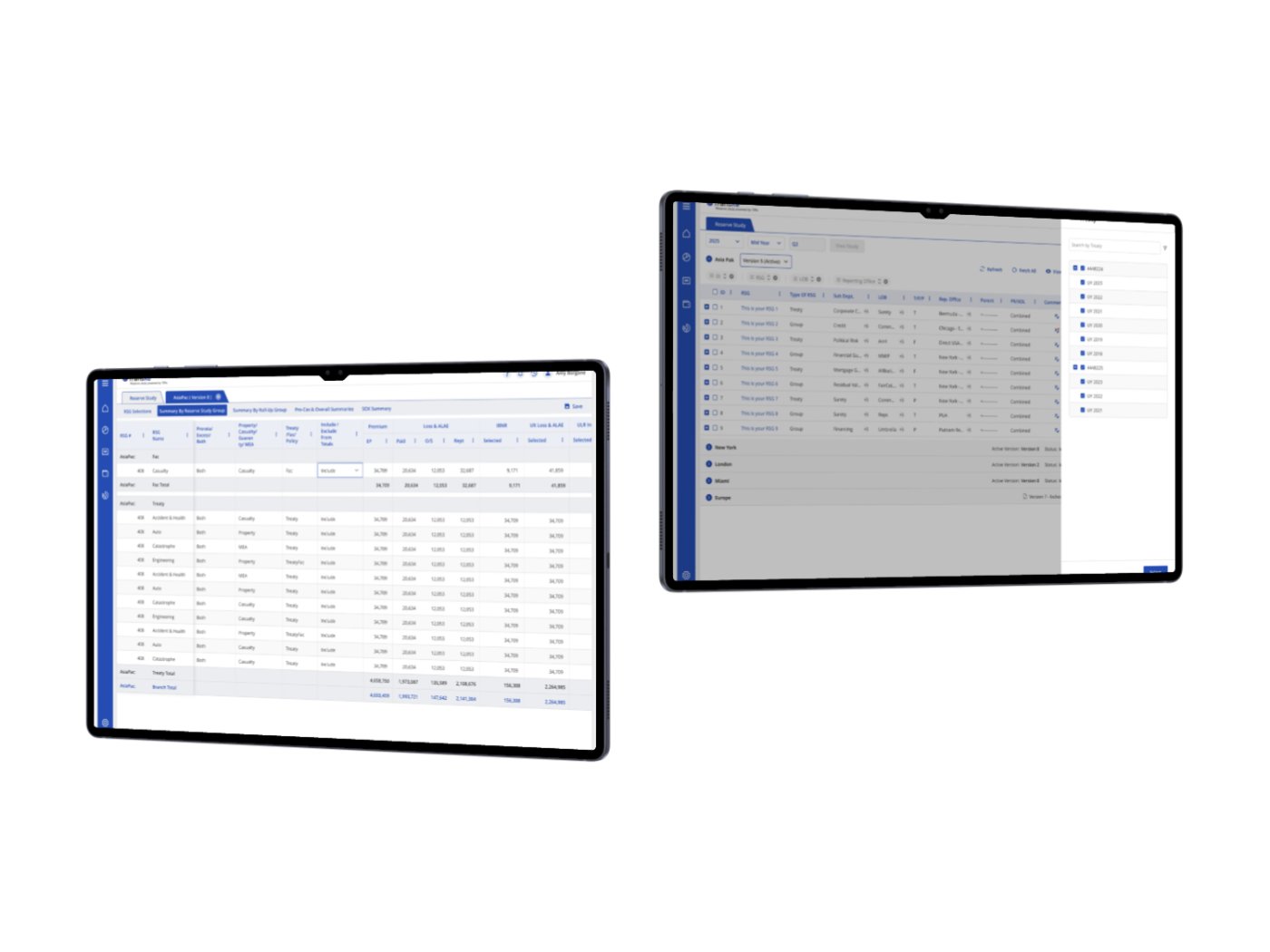
The resultReserve Study replaced TransRe's spreadsheet workflow with a dedicated internal CRM built around their actual data and daily questions:
A single source of truth
all reserve data now lives in one structured system instead of scattered Excel files, ending version confusion.
Advanced filtering that changed daily work
complex, multi-criteria queries that once took manual effort in Excel now take seconds.
Designed for heavy data
dense, readable tables let employees work with large datasets comfortably, without the fragility of massive spreadsheets.
Structured and safe
controlled data entry and clear feedback replaced the silent, untraceable errors of spreadsheet editing.
A smoother transition from Excel
by preserving familiar table behaviors, adoption felt like an upgrade, not a disruption.
Reserve Study proved a simple principle: when people outgrow their spreadsheets, the answer isn't a prettier table, it's a system designed around their data and the questions they ask of it.
Key learnings
What I took awayThe data model is the design, understanding the spreadsheet was the real research.
Replace tools by keeping their strengths, familiar table behavior made adoption feel like an upgrade.
Filtering is a feature, not a control, advanced filters turned minutes of work into seconds.
Density can be calm, typography and alignment let large datasets stay readable.
More projects
S&P Global: CIQ PRO Dashboard
S&P Global: Chart Explainer
Vodafone Qatar: Agent Platform
Contact me
Let's work together
Have a project in mind, or just want to say hi? I'm always open to new conversations.