Harvard Law School: SHARIAsource
How I made centuries of Islamic legal scholarship searchable in one place, across ~700K records
A fatwā written centuries ago and a journal article published last month answer the same question, and no library held both.
Designer on the portal: the search architecture, reader templates across six content formats, and the tools contributors use to add sources.
Role
Designer
Category
Digital Library / Legal Research
Timeline
2022
Hijri + CE
Dual-calendar dating built in
6 formats
Articles, PDFs, video, journals, images, people
In-place
Every format read without leaving
Harvard
Law School research platform
“Centuries of fatwās, manuscripts, and lectures, one well-crafted search away.”
Client feedback
Overview
The contextShariahSource is Harvard Law School's research platform for Islamic law, a scholarly digital library in the tradition of ACM Digital Library and IEEE Xplore, but built for a very different corpus: fatwās, historical primary sources, journals, articles, images, and video lectures spanning centuries of Islamic legal thought.
The platform serves researchers, students, and scholars who need to search across hundreds of thousands of records (the design accounts for result sets of nearly 700,000 items) and drill into individual documents with full academic context: abstracts, structured metadata, tables of contents, references, footnotes, and related materials. My work covered the end-to-end experience, from the search-first landing page, through intelligent search and filtering, to rich article pages that handle text, embedded PDFs, and video seamlessly.
Challenge
The problemScholarly search is unforgiving. Academic users don't browse casually, they arrive with precise questions and expect precise tools. A platform of this scale lives or dies by whether a researcher can go from query to the exact document they need in seconds. Generic search patterns weren't enough.
The corpus is uniquely complex
Islamic legal scholarship demands specialized dimensions of discovery: documents dated in both Hijri and Gregorian calendars (1435 / 2014), organized by empires and eras, original languages, geographic regions, document types, and themes. Off-the-shelf filters from ACM or IEEE Xplore have no vocabulary for "Empire: Early Rule" or a CE/Hijri date toggle.
Content lives in many formats
A single research topic might span a written article, a scanned historical manuscript in Arabic, and a recorded lecture. The platform had to treat articles, PDFs, videos, journals, and images as first-class citizens, searchable, browsable, and readable, without fragmenting into disconnected silos.
Depth without overwhelm
An article page carries enormous scholarly apparatus: abstract, metadata cards, document outline, authors, figures, references, keywords, metrics, footnotes, related articles, suggested videos, and access controls. Presenting all of it while keeping the reading experience calm was a central tension.
The core problem: bring the rigor of the world's best academic libraries to Islamic law scholarship, with search, filters, and reading experiences designed for this corpus, not borrowed from another field.
Approach
The processA search-first entry point
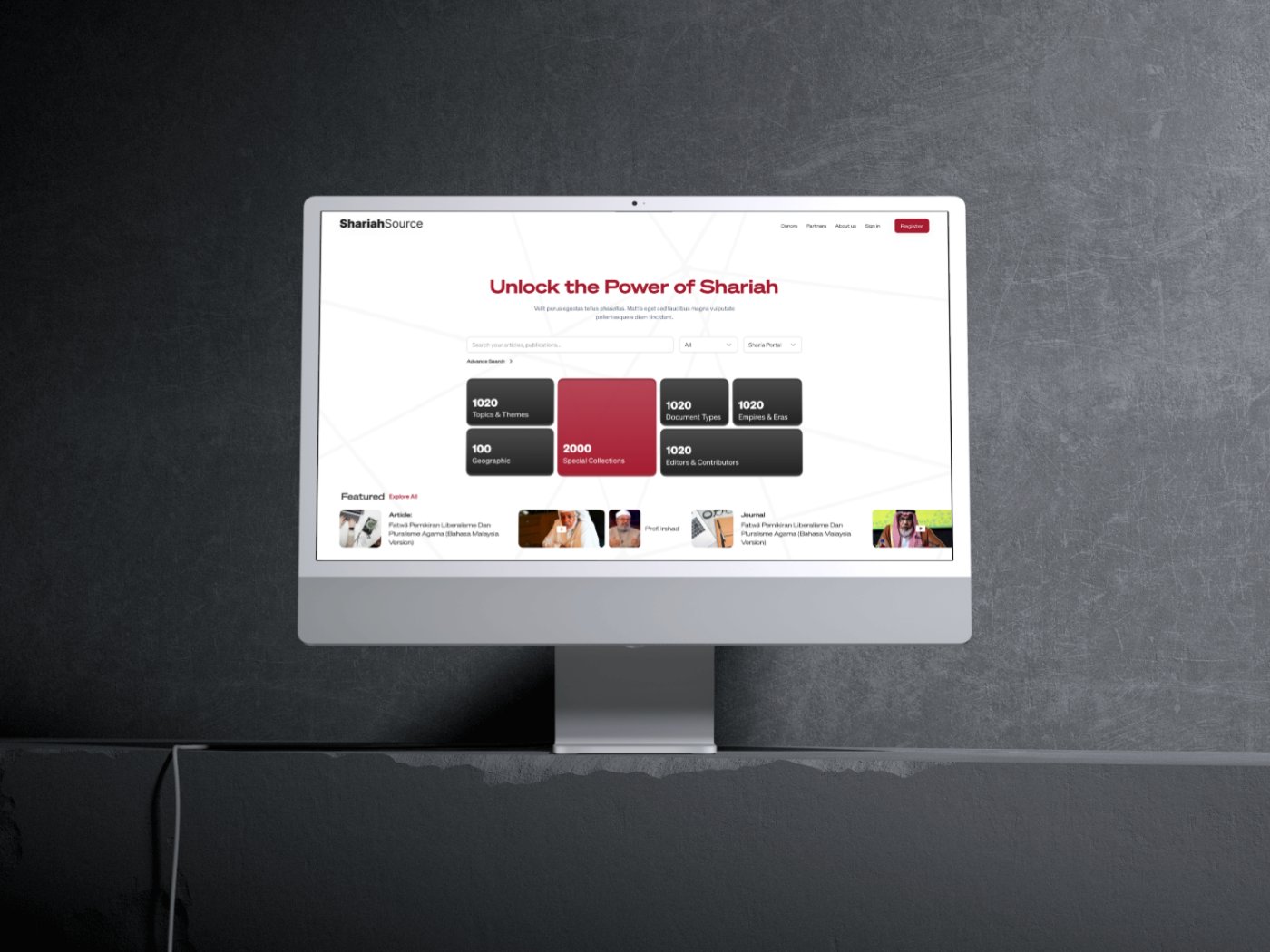
The landing page puts one thing at the center: a large search bar with scoped dropdowns (content type and portal), framed by the promise "Unlock the Power of Shariah." Below it, the collection is made tangible through browsable stat tiles, Topics & Themes, Special Collections, Document Types, Empires & Eras, Geographic regions, and Editors & Contributors, with a Featured strip surfacing articles, journals, and videos immediately.
Autocomplete that understands the corpus
As a researcher types, search suggests completions grouped by content type, Video, Image, Journal, and community results, alongside a direct "Just search for" action with a visible Enter shortcut. The dropdown also lets users pre-scope a query to Images, Journals, Articles, Videos, or Metatags before ever hitting search.
Advanced search built for Islamic scholarship
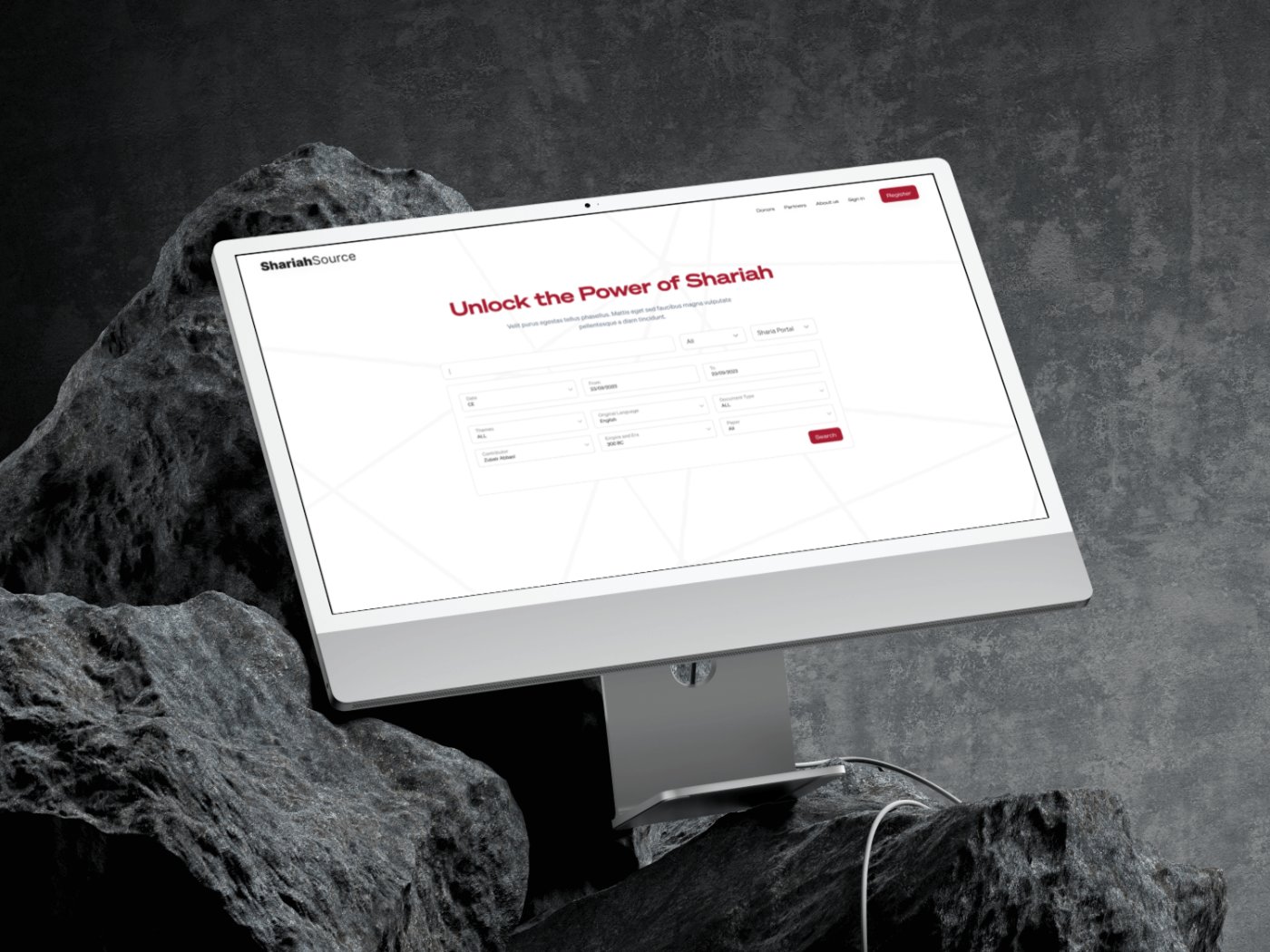
The advanced panel exposes the dimensions this field actually needs: a CE/Hijri date-system selector with from/to ranges, Themes, Original Language, Document Type, Contributor, Empire and Era, and Paper type. This is where the platform departs most clearly from generic academic search, the filters speak the researcher's language.
Results built for scale
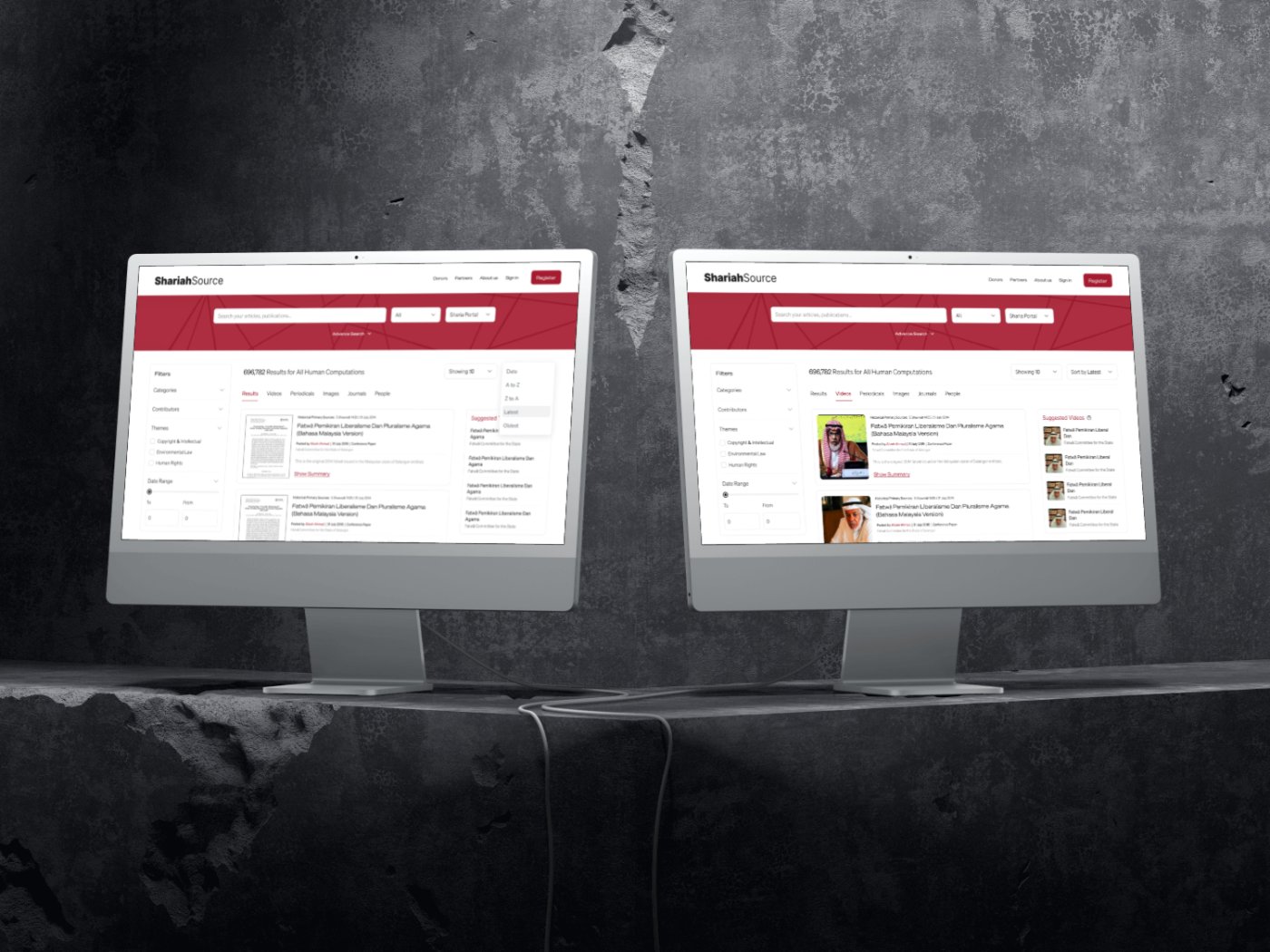
The results page handles ~696,000-item result sets: a persistent left rail of filters (Categories, Contributors, Themes, Date Range slider), content-type tabs (Results, Videos, Periodicals, Images, Journals, People), sorting, configurable page size, and pagination. Each card carries its scholarly identity, thumbnail, dual-calendar dating, title, contributor, date, document type, and an expandable summary, so relevance can be judged without opening anything.
Article pages with full academic apparatus
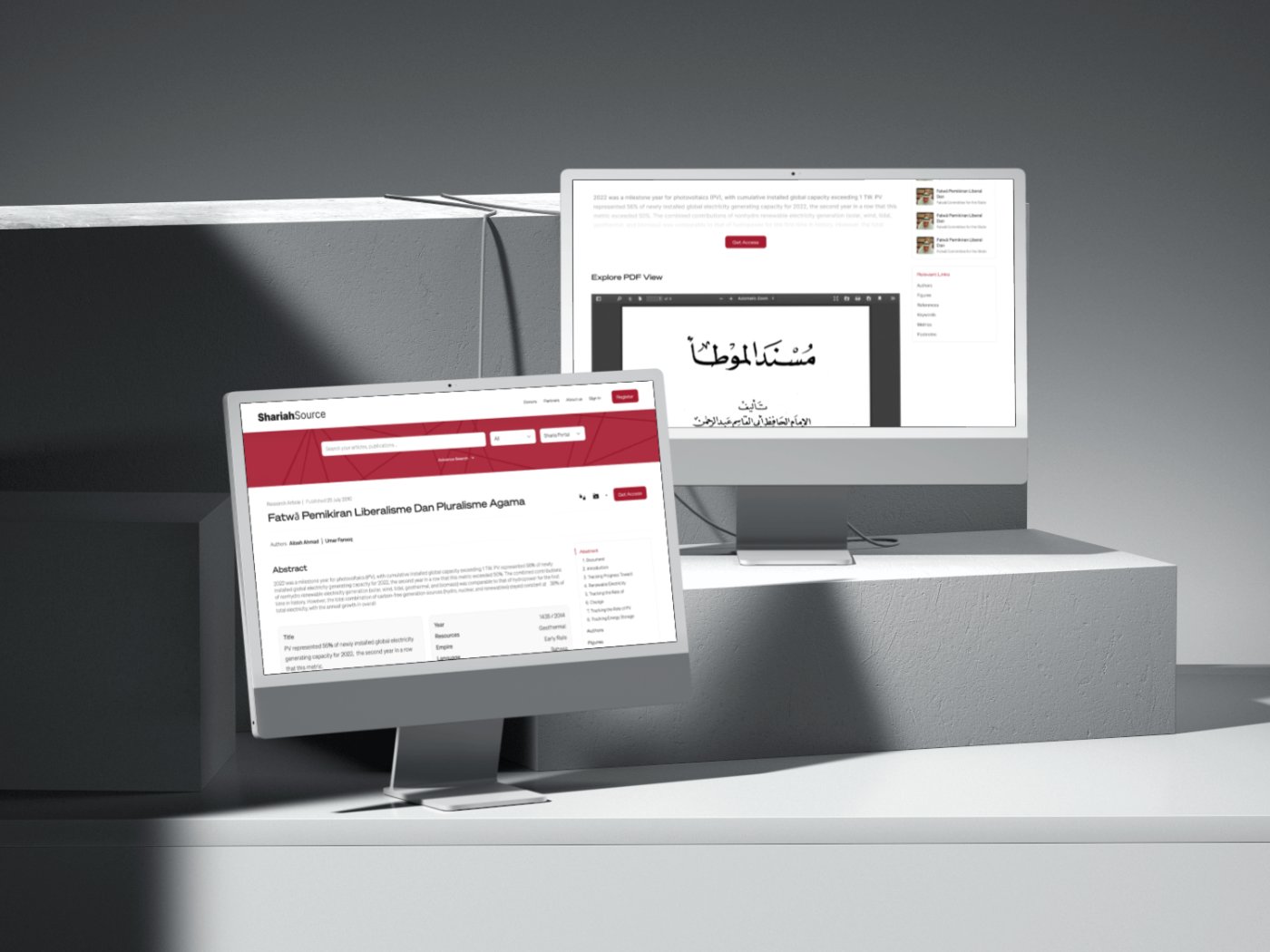
The document page is organized around a reading spine: category and date, title, authors, and abstract up top; structured metadata cards (Year in Hijri/Gregorian, Resources, Empire, Language); and a sticky table of contents that tracks Document, Introduction, and every section down to Authors, Figures, References, Keywords, Metrics, and Footnotes. Quick Links and Related Articles extend the trail onward.
Every format, in place
Rather than bouncing users out to separate viewers, content renders inside the article page: an embedded PDF viewer with full toolbar (zoom, pagination, print, download, bookmarks) for scanned primary sources, including right-to-left Arabic manuscripts, and an inline video player with Related and Suggested Videos rails for recorded lectures.
A clear access model
For gated scholarship, the design previews the abstract and fades the full text behind a prominent Get Access call-to-action, echoing patterns academics already know from major digital libraries, with sharing and citation affordances alongside the title.
A restrained, institutional visual language
A crimson-anchored palette (fitting its Harvard home), generous whitespace, and a subtle geometric background pattern give the platform an authoritative identity that never competes with the content. Status colors, chips, and table patterns stay consistent from search results to article metadata.
Outcome
The resultA complete scholarly research platform for Islamic law, search, autocomplete, advanced filtering, multi-format results, and deep article pages, designed as one coherent system:
Search that speaks the field's language
Hijri/CE dual dating, empires and eras, original languages, and document types make discovery precise for this corpus in a way no generic library platform offers.
True multi-format research
articles, PDFs of historical manuscripts, video lectures, journals, and images are all first-class: searchable through the same bar, filterable in the same results page, and readable without leaving the platform.
Built for scale
the browsing experience holds up against result sets approaching 700,000 records through layered filters, tabs, sorting, and scannable result cards.
Reading-first article design
a sticky outline, structured metadata, and progressive disclosure keep dense scholarly apparatus available without crowding the text itself.
ShariahSource gives Islamic legal scholarship the kind of digital home computer science has long had in ACM and IEEE Xplore, a place where centuries of fatwās, manuscripts, and lectures are one well-crafted search away.
Key learnings
What I took awayDesign for the corpus, not the category, Hijri/CE dating and empires-and-eras filters had to be invented, not borrowed from ACM or IEEE.
Multi-format is a search problem first, articles, PDFs, and video only feel unified when one search bar and one results page cover them all.
At scale, cards must be scannable, with ~700K results, relevance has to be judgeable without opening anything.
Calm carries dense apparatus, a sticky outline and progressive disclosure let heavy scholarly metadata coexist with reading.
More projects

S&P Global: CIQ PRO Dashboard
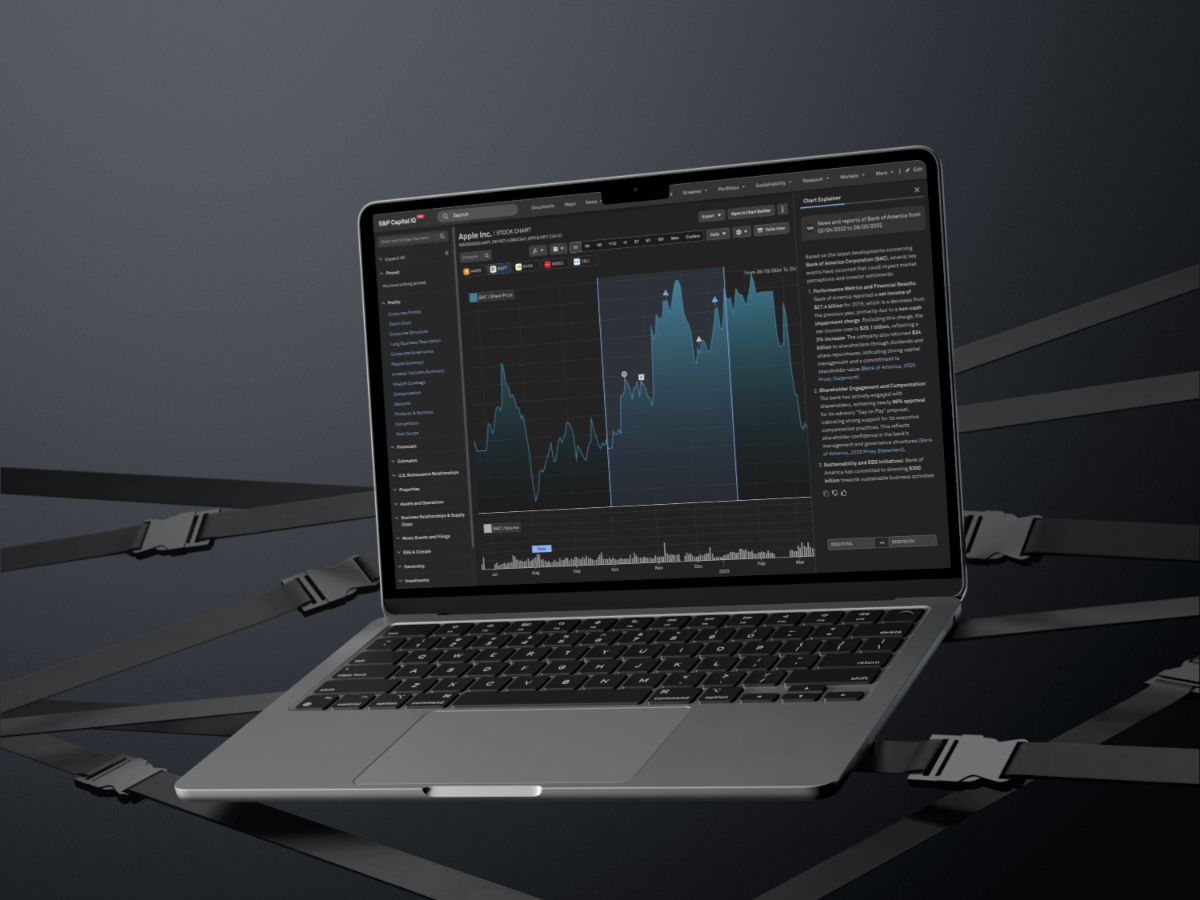
S&P Global: Chart Explainer
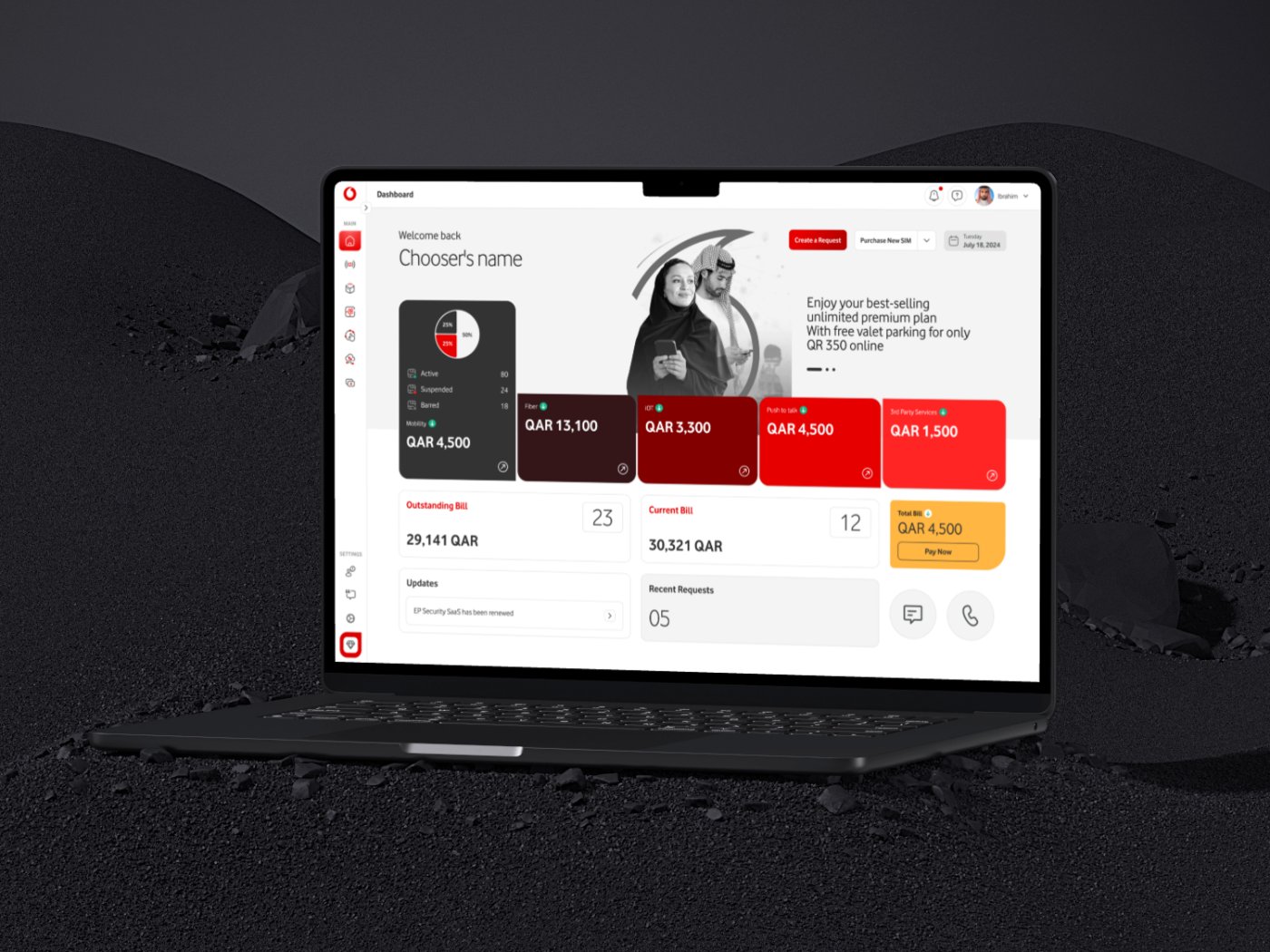
Vodafone Qatar: Agent Platform
Contact me
Let's work together
Have a project in mind, or just want to say hi? I'm always open to new conversations.